Abstract
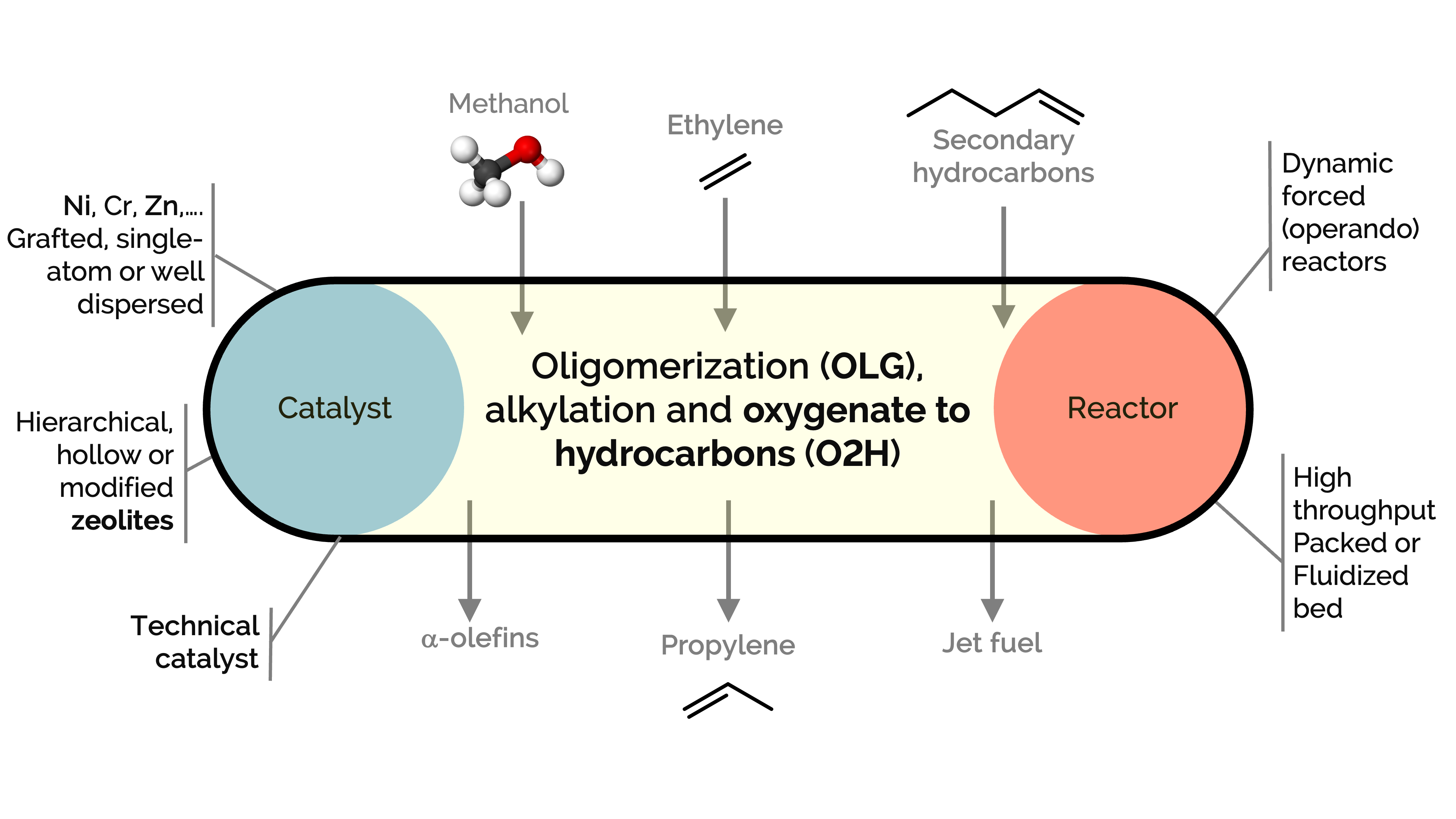
Metal cations in zeolites can redirect alkene oligomerization from Brønsted-acid-mediated secondary chemistry toward coordination-insertion pathways; however, controlling whether metal precursors form accessible cationic sites or oxide nanoparticles remains challenging. Here, we prepared hierarchical ZSM-5 by polymeric templating (PT) at a common nominal loading of 3 wt % and compared the protonic parent H/PT with Ni/PT, Cr/PT, and Zr/PT to determine how metal speciation governs ethylene oligomerization. X-ray diffraction, N2 physisorption, microscopy, X-ray photoelectron spectroscopy, in situ X-ray absorption spectroscopy, CO-DRIFTS, pyridine-FTIR, and multinuclear solid-state NMR show that Ni/PT is dominated by accessible, framework-interacting Ni2+ Lewis sites, with a minor NiO-like contribution. Cr/PT contains accessible Cr-associated Lewis sites together with CrOx-like domains that evolve toward Cr2O3 during pretreatment, whereas Zr/PT is dominated by ZrO2 nanoparticles and retains more Brønsted acidity than Ni/PT and Cr/PT. These differences reshape catalytic activity: Ni/PT achieves 92% combined C4–C8 olefin selectivity with a butene-rich, dimerization-dominated slate, whereas Cr/PT gives a C6-rich distribution from a mixed network of Cr-associated Lewis sites and residual acid-mediated chemistry; H/PT and Zr/PT instead favor hydrogen transfer, aromatization, and paraffin formation. Density functional theory on an initiated [Ni(II)–ethyl]+ model places β-hydrogen transfer/chain termination 10 kJ mol–1 below further ethylene insertion, rationalizing the C4-rich response. The coke content increases in the order H/PT < Ni/PT < Cr/PT < Zr/PT, whereas total retained-deposit content follows H/PT < Cr/PT < Ni/PT < Zr/PT. Thus, olefin selectivity and deposit formation do not vary in parallel. Within this matched catalyst series, chain-length selectivity and deactivation reflect the coupled effects of metal speciation, site accessibility, thermal evolution, and residual acidity rather than nominal metal loading, total Lewis acidity, or texture alone.
Keywords
OLG
HCE