​​

Design and development of unconventional catalytic conversion processes using electrons, photons, and microorganisms


    Problem Statement

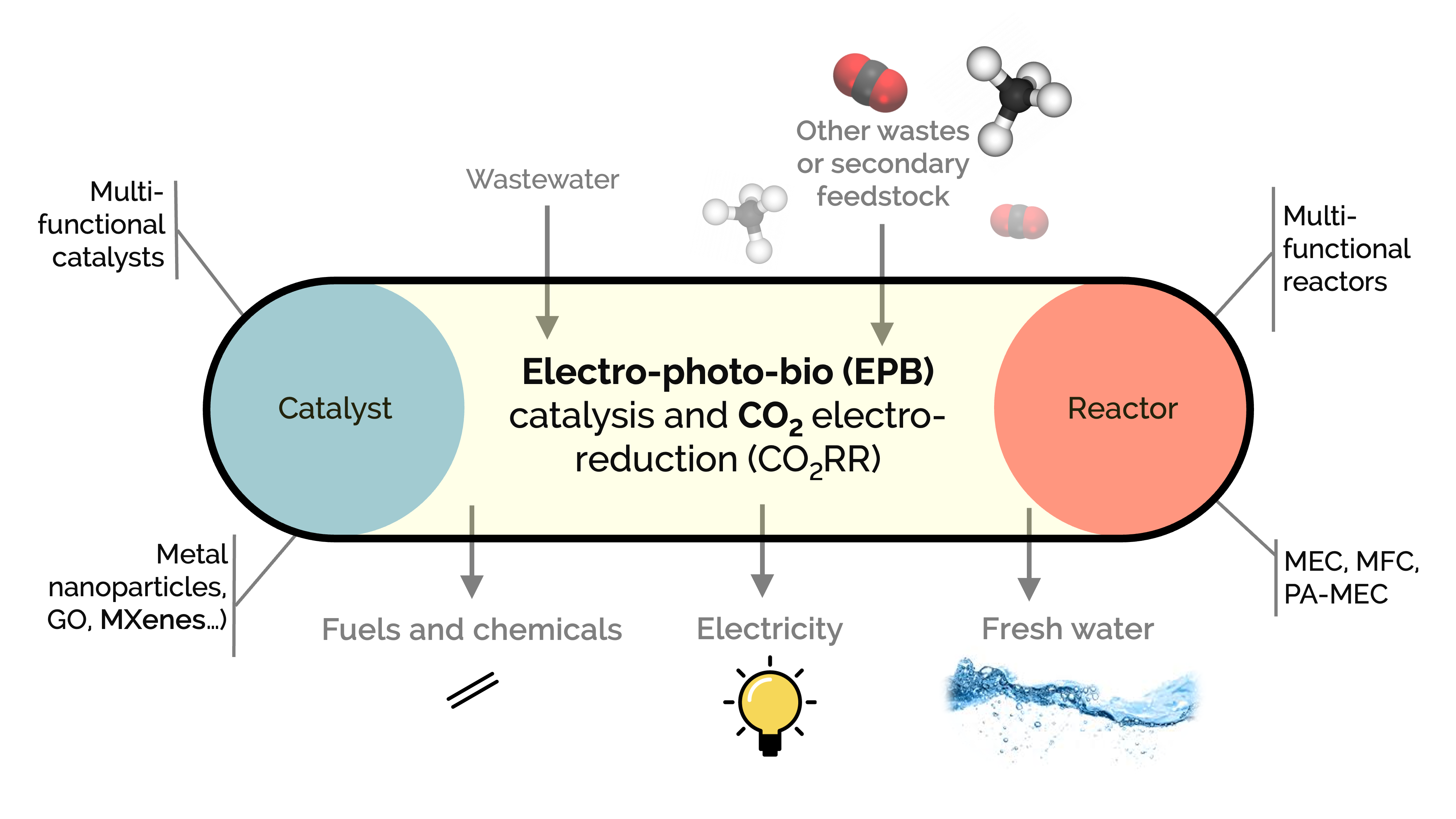
    Our long-term commitment to sustainability and a circular carbon economy involves unconventional catalytic conversion processes. We study various processes assisted by electrons, photons, or microorganisms to produce biofuels, chemicals, electricity, or treated water. For example, bio-electro-chemical systems, including microbial fuel cells (MFCs), electrolysis cells (MECs), and photo-assisted cells (PA-MECs), are promising technologies for simultaneously producing renewable energy and cleaning wastewater using active microorganisms as biocatalysts. On the other side, we also work heavily in CO₂ electroreduction or CORR

    Our work aims to synthesize multifunctional catalysts and reactors to enhance electrical conductivity, efficiency, microbiological affinity, porosity, hydrophilicity, and surface area of carbonaceous electrodes. We work with materials such as graphene oxide, metallic nanoparticles, nitride and carbide basic materials, and MXenes.

    We consider new platform technologies to produce renewable biofuels and chemicals, and treat wastewater using nanotechnology and a reaction-engineering approach, combining them to increase the productivity of these processes.
    EPB

    Goals

    • Develop and scale up electro-photo-bio-catalyst and -reactors
    • Propose novel processes to clean wastewater and produce electricity, chemicals, and bio-hydrogen
    • Model and simulate fuel cell performance
    • Use innovative catalysts (anode and cathode material) and reactor designs to improve fuel cell performance

    Related People

    Related Publications

    NiCoOx@NiCo core–shell nanoparticles supported on Ti3C2Tx as cathode electrocatalyst for microbial fuel cells

    by Kolubah, Mohamed, Hedhili, Hassine, Ahmad, Velisoju, Emwas, Dally, Cavallo
    J. Mater. Chem. A Year: 2026 DOI: https://doi.org/10.1039/d6ta03240k

    Abstract

    The intrinsically sluggish oxygen reduction reaction (ORR) at platinum-group-metal-free cathodes remains a key bottleneck for the practical deployment of microbial fuel cells (MFCs). Ti3C2Tx MXene is a promising conductive scaffold, yet its ORR activity is hindered by strong O2 adsorption at Ti sites, leading to sluggish kinetics at neutral pH. Here, we address this limitation by developing a targeted chemical-reduction strategy that assembles NiCo alloy nanocores encapsulated in a thin NiCo-oxide shell (∼4 nm) onto Ti3C2Tx, forming a (NiCoOx@NiCo)/Ti3C2Tx heterostructure catalyst. The core–shell domains modulate the local electronic environment, lower the O2 binding energy, and introduce abundant active sites, thereby leveraging the high conductivity of Ti3C2Tx. As an air-cathode MFC treating glucose-supplemented wastewater, the catalyst delivers a current density of 4.5 A m−2 and a peak power density of 1.6 W m−2, outperforming pristine Ti3C2Tx. This work establishes a generalizable heterostructure design strategy for activating MXene-based catalysts toward efficient neutral-pH ORR, bridging fundamental catalyst design with practical microbial fuel cell applications.

    Keywords

    HCE EPB