​​

Controlling the selectivity–stability tradeoff in zeolite catalysis: oligomerization–alkylation, cracking, and methanol-to-hydrocarbons 


    Problem Statement

    Olefins and aromatics are commodity chemicals used in producing plastics (in the petrochemical industry), lubricants, plasticizers, and surfactants, among other products. However, there is an imbalance between their production and demand, which reactions like oligomerization, alkylation, and cracking over zeolites could help address. At the same time, zeolites serve as excellent catalysts for converting methanol to hydrocarbons (MTH), olefins (MTO), or aromatics (MTA). These processes aim to produce light hydrocarbons such as propylene or to convert ethylene into higher-value alpha-olefins, aromatic hydrocarbons (BTX), and jet fuel.
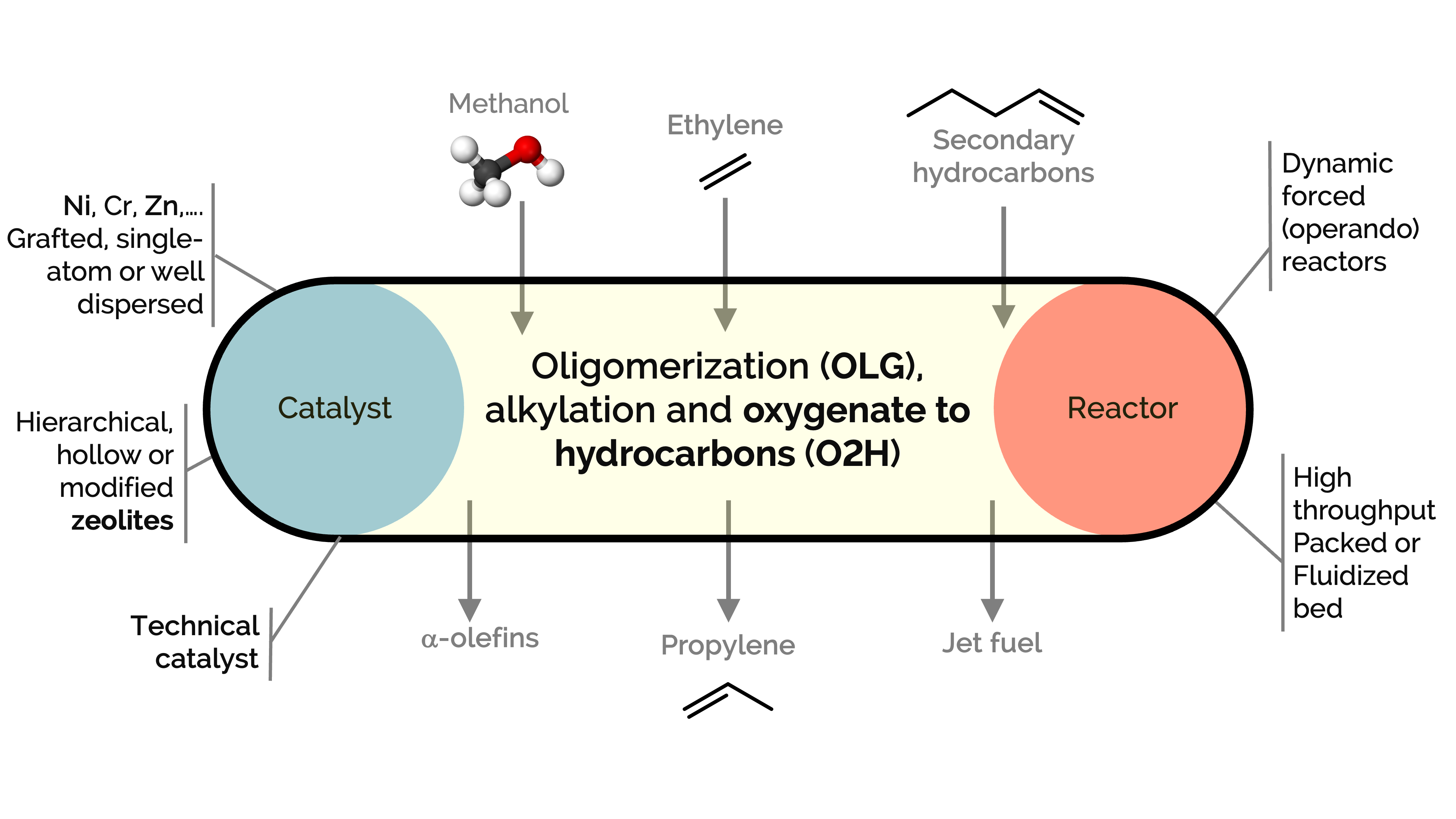

    Our focus in this project is to synthesize, modify, and develop new catalysts with engineered porosity at multiple scales: from hierarchical and hollow zeolites to catalytic particles, bodies, or technical catalysts intended for implementation. Additionally, we incorporate various metals (e.g., Ni, Cr, Zn) to influence the selectivity toward the desired products.

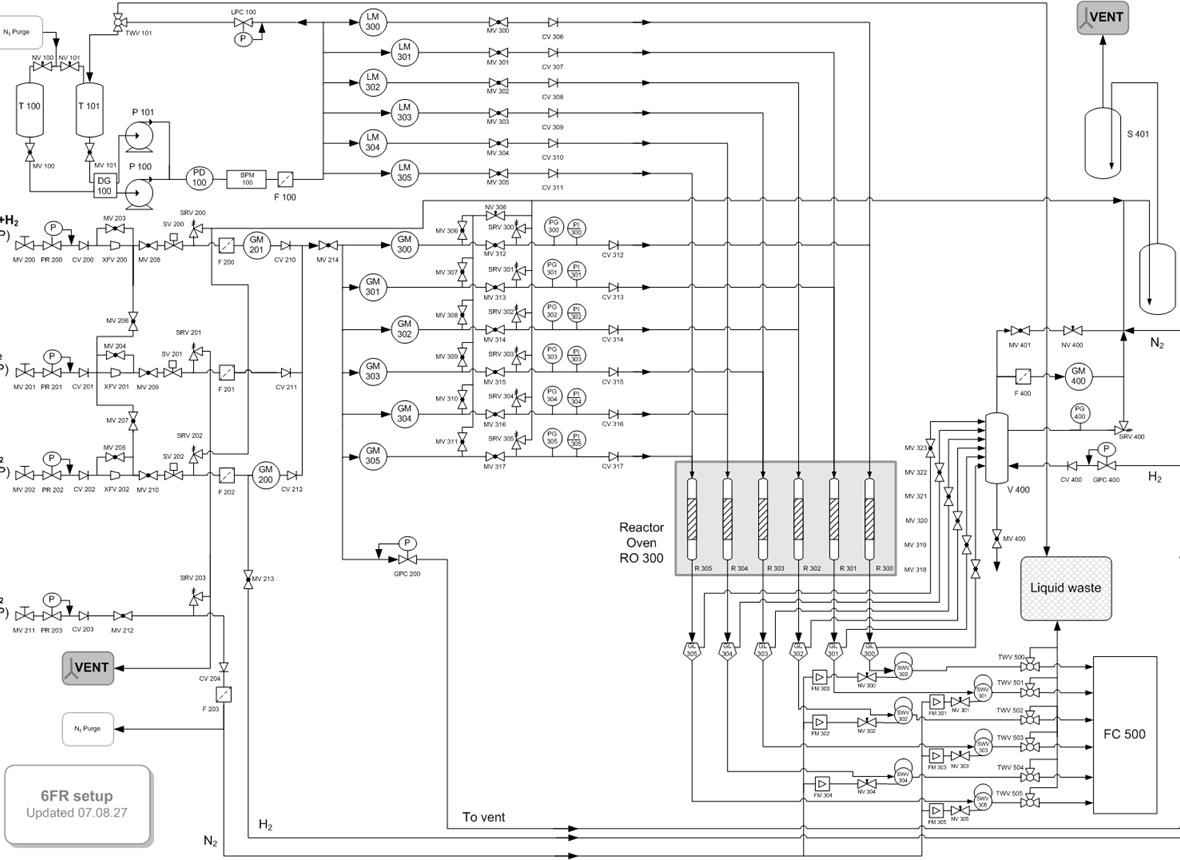
    We utilize various reactors, including forced dynamic, operando, high-throughput packed-bed, and batch reactors.

    OLG-O2H

    Goals

    • Control the catalyst structure to balance selectivity and stability.
    • Metal modulation: Use Ni, Cr, Zn to bias reaction pathways and improve selectivity to target hydrocarbons.
    • Deactivation control: Reduce coke formation and extend catalyst lifetime with regeneration strategies.
    • Reactor optimization: Shape catalysts into bodies/extrudates and validate 100 h continuous stable operation.

    Related People

    Related Publications

    Stable and reusable hierarchical ZSM-5 zeolite with superior performance for olefin oligomerization when partially coked

    by Mohamed, Parsapur, Hita, Cerrillo, Ramirez, Huang, Castaño
    Appl. Catal. B: Environ. Year: 2022 DOI: https://doi.org/10.1016/j.apcatb.2022.121582

    Abstract

    The character of coke is typically regarded as a “deactivator” in zeolite catalysis. We report the interdependence of coke nature and location with its true character in the mechanisms of ethylene oligomerization: a model zeolite catalyzed transformation involved in many sustainable processes. We prepared, characterized, and tested ZSM-5 zeolites of different diffusion paths and acidities, using polymeric-, organic-template, or template-free strategies and various Si/Al ratios. The results indicate that coke can improve the selectivity/yield of higher olefins and jet-fuel aliphatics, and this positive effect is better than modifying the number of acid sites. The molecular-level nature of these coke species is elucidated using high-resolution mass spectrometry. The “enhancer” character of the coke can be better exploited in polymeric templated (hierarchical) ZSM-5 zeolite because mesopores retain coke without critically affecting accessibility or causing deactivation. Furthermore, this catalyst is stable for at least 74 h on stream and in multiple reaction-regeneration cycles.

    Keywords

    OLG HCE