​​

Controlling the selectivity–stability tradeoff in zeolite catalysis: oligomerization–alkylation, cracking, and methanol-to-hydrocarbons 


    Problem Statement

    Olefins and aromatics are commodity chemicals used in producing plastics (in the petrochemical industry), lubricants, plasticizers, and surfactants, among other products. However, there is an imbalance between their production and demand, which reactions like oligomerization, alkylation, and cracking over zeolites could help address. At the same time, zeolites serve as excellent catalysts for converting methanol to hydrocarbons (MTH), olefins (MTO), or aromatics (MTA). These processes aim to produce light hydrocarbons such as propylene or to convert ethylene into higher-value alpha-olefins, aromatic hydrocarbons (BTX), and jet fuel.
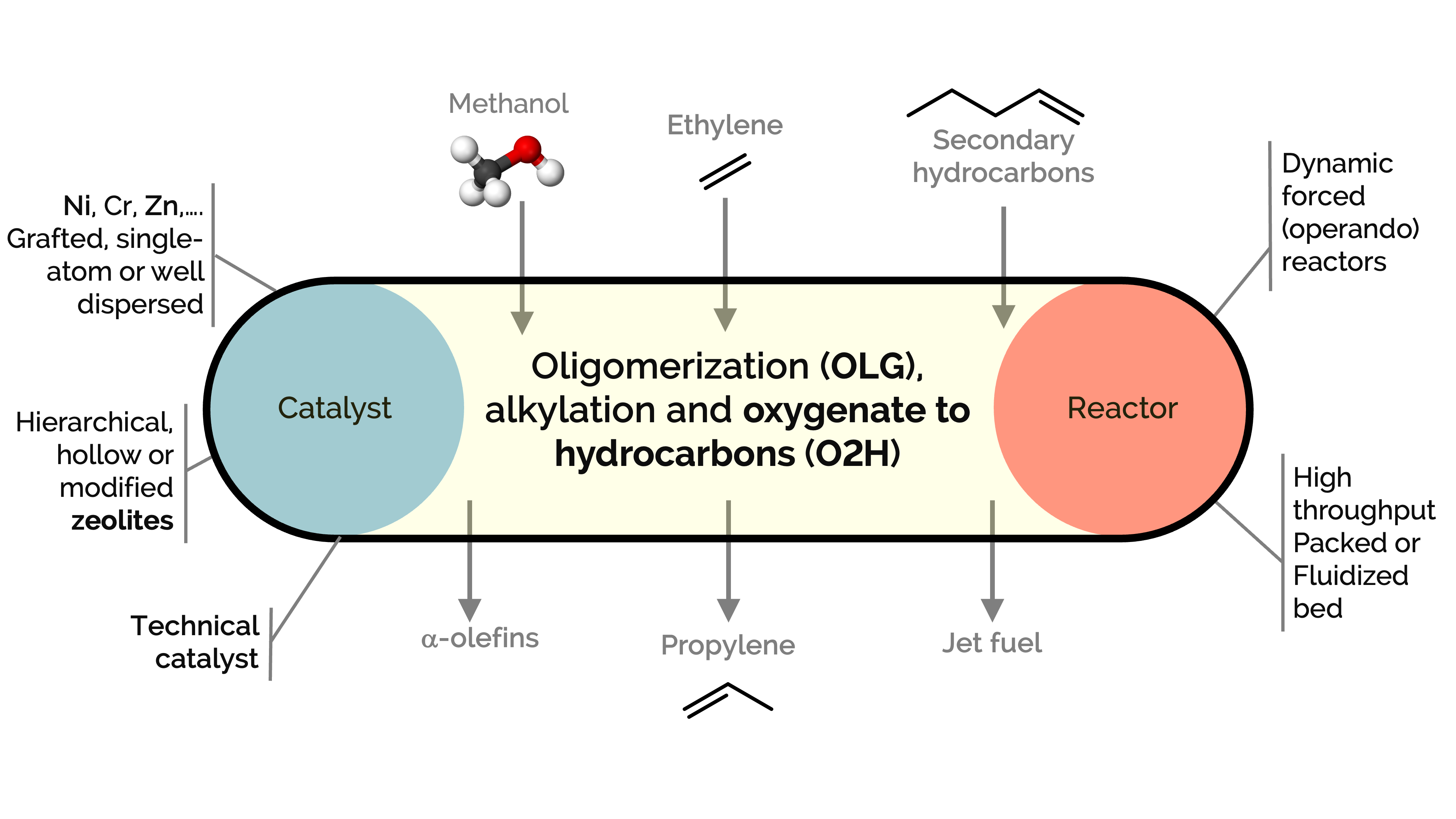

    Our focus in this project is to synthesize, modify, and develop new catalysts with engineered porosity at multiple scales: from hierarchical and hollow zeolites to catalytic particles, bodies, or technical catalysts intended for implementation. Additionally, we incorporate various metals (e.g., Ni, Cr, Zn) to influence the selectivity toward the desired products.

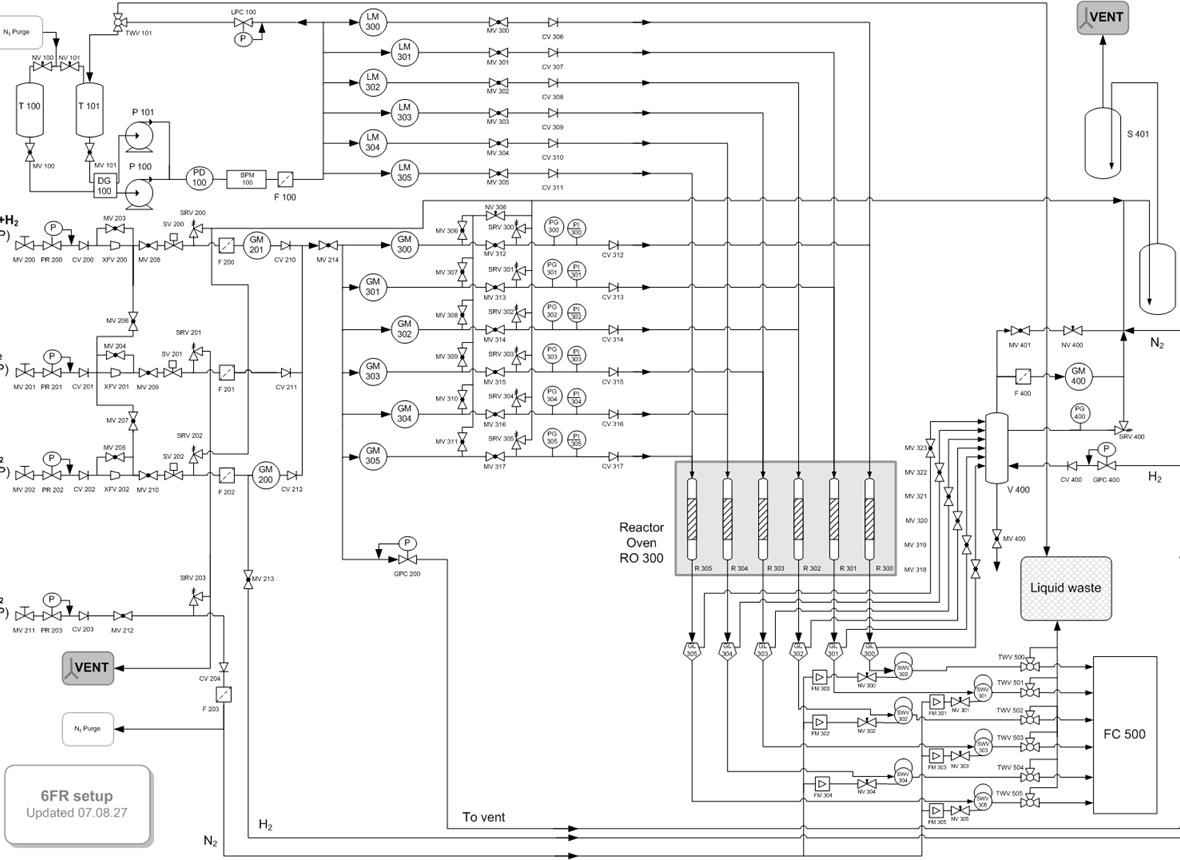
    We utilize various reactors, including forced dynamic, operando, high-throughput packed-bed, and batch reactors.

    OLG-O2H

    Goals

    • Control the catalyst structure to balance selectivity and stability.
    • Metal modulation: Use Ni, Cr, Zn to bias reaction pathways and improve selectivity to target hydrocarbons.
    • Deactivation control: Reduce coke formation and extend catalyst lifetime with regeneration strategies.
    • Reactor optimization: Shape catalysts into bodies/extrudates and validate 100 h continuous stable operation.

    Related People

    Related Publications

    Catalytic Deactivation Pathways During the Cracking of Glycerol and Glycerol/VGO Blends under FCC Unit Conditions

    by Errekatxo, Ibarra, Gutierrez, Bilbao, Arandes, Castaño
    Chem. Eng. J. Year: 2017

    Abstract

    The deactivation during the cracking of glycerol into valued chemicals and fuels has been studied under realistic FCC conditions using HZSM-5 or HY zeolite based catalysts. These catalysts suffer a severe catalyst deactivation by coke, which has been characterized quantitatively and qualitatively by TG-TPO, MS/FTIR-TPO, FTIR, 1H and 13C NMR spectroscopies. The first part of this work delves with the product distribution and deactivation of HZSM-5 zeolite based catalyst during the transformation of (pure) aqueous glycerol. The second section focuses on the product distribution and deactivation of HY zeolite based catalyst during the joint cracking of vacuum-gas-oil (VGO) with aqueous glycerol. The results show that the mechanism of deactivation during glycerol cracking, independently of the catalyst used, involves two sequential steps: (i) condensation in the exterior of the zeolite to form an oxygenated coke and (ii) dehydration and hydrogen transfer of the previous oxygenated coke to form a more aromatic one. The second step is only activated at severer conditions (t > 3 s and T > 450 °C). Co-feeding glycerol with VGO increase the yield of coke, gases and decrease the yield of gasoline (with higher octane number), while VGO only participates in the formation of aromatic coke.

    Keywords

    O2H W2C CRE