Multiscale kinetic modeling in catalysis: from microkinetics to computational fluid dynamics and process simulation. We connect models from the elementary step to the plant. Each scale passes parameters to the next, and design questions travel back down. Models are built together with the experiments of the other three competencies and are validated against them, so experiments are planned with the model, not guessed.
Problem statement. Catalytic processes occur at several scales at once: elementary steps on active sites, diffusion and heat transfer inside particles, hydrodynamics in the reactor and integration in the process. A model at one scale is not enough when the limiting phenomenon sits at another. Kinetic models fitted to limited or noisy data are not robust enough for scale-up.
We see multiscale modeling as the tool that links reaction understanding, catalyst and reactor design, scale-up and process optimization. We address each scale individually and the chain as a whole.
Our approach, scale by scale. The video zooms from the plant to the electrons, and each paragraph below matches one scene.
1. Process: the plant as a whole. Process models evaluate recycles, heat integration, energy use and scale-up scenarios. We use process system engineering (gPROMS and other packages) for ammonia crackers and reformers, including repurposing methane steam reformers as ammonia crackers [175], and for hydrocracking units, including techno-economic analysis [148]. These models need a reliable reactor model inside.
2. Reactor: flow, heat and solids. We couple hydrodynamics, heat transfer and kinetics in computational fluid dynamics:
3. Particle: reaction against transport. Inside each particle, reaction competes with diffusion and heat transfer. This determines how much of the catalyst actually works. Particle models connect intrinsic kinetics with the shaped catalyst, including the effect of SiC and of the shaping method [190], and population balances describe how particles grow during shaping [204].
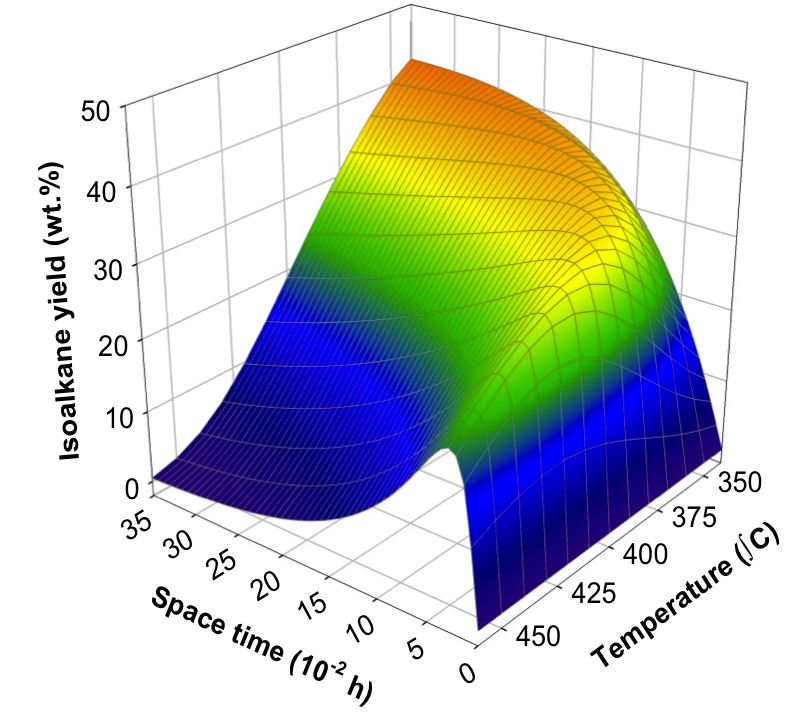
For complex feeds, macrokinetic models (lumped and empirical) are often the most robust choice. They detect changes in mechanism, optimize conditions and support reactor pre-design. We make them robust with:
4. Surface: microkinetics. Microkinetic models resolve the rate of each elementary step, the rate-determining step, and adsorption and desorption, with thermodynamic constraints imposed [168] . Langmuir-Hinshelwood and Eley-Rideal formulations are used where they apply. We applied this approach to promoters and active sites in:
5. Electrons: DFT. Density functional theory (DFT) supplies adsorption and barrier energies, supports the assumed pathways and provides initial parameter estimates [140, 180] . From here, parameters move up the chain to the process, and design questions move back down.
Goals. Our goals are grouped in these lines of work:
Applications. We apply this competency to: