​​

Reactor design and optimization for converting crude (and refinery wastes) to chemicals in one step through revamped fluidized catalytic cracking

    Problem Statement

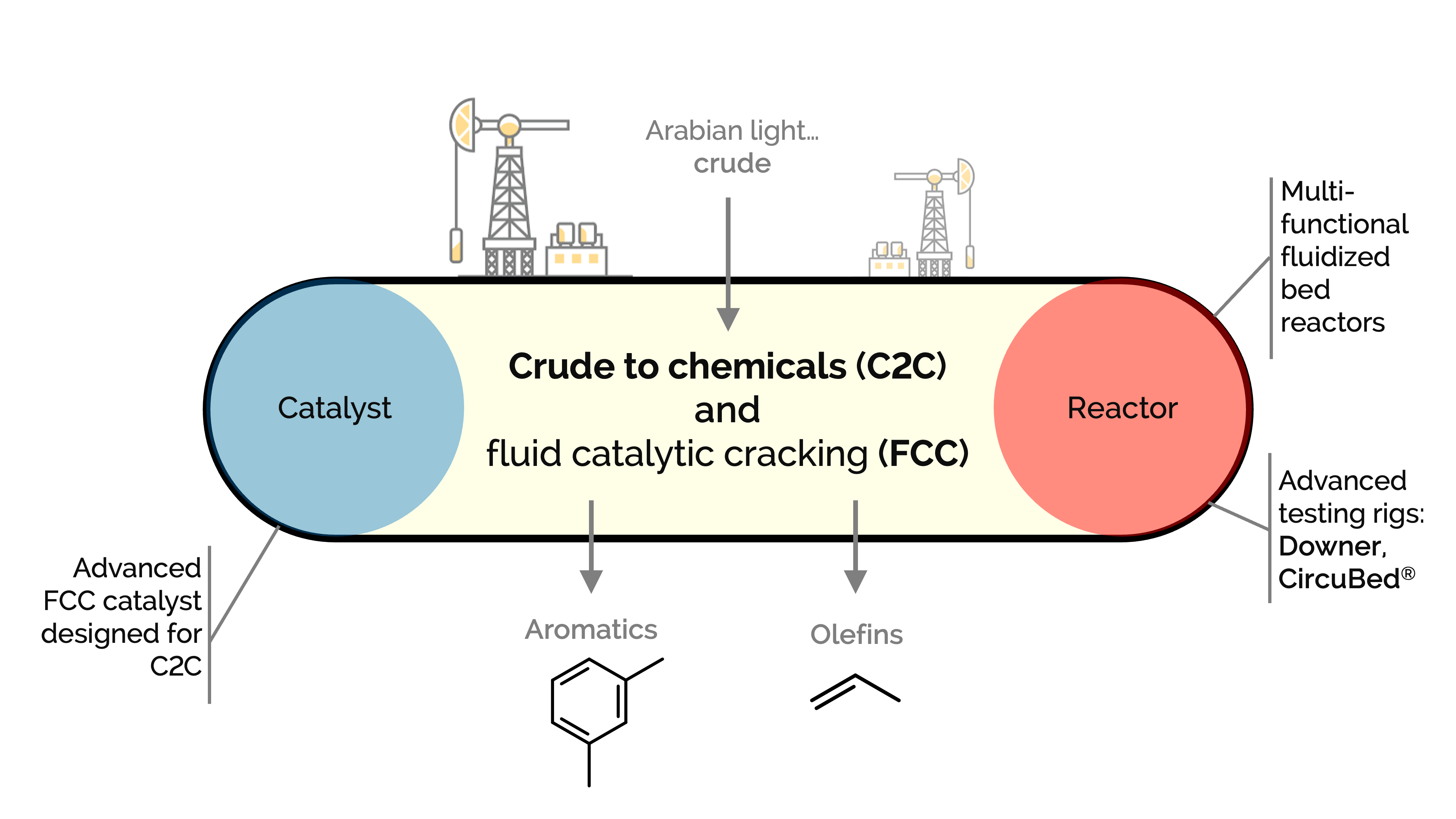
    Direct catalytic cracking of crude oil to chemicals could soon dominate the petrochemical industry, with lower fuel consumption and increased production of light olefins and aromatics. We aim to simplify the refinery into a single-step conversion scheme to produce the most demanded petrochemicals.

    Using a bottom-up holistic approach, we design a catalytic crude-to-chemicals process toward this goal. We investigate advanced reactors with intrinsic kinetic data and controlled hydrodynamics to improve the process. We study nonlinear multiscale phenomena by coupling hydrodynamics, heat transfer, and reaction kinetics.

    We use particle image velocimetry and optical probes, kinetic modeling, computational particle-fluid dynamics, and optimization approaches to improve operating scenarios and develop innovative reactor prototypes.

    We focus on the catalyst, reactor, and process levels to enhance and intensify the system. We are optimizing several state-of-the-art laboratory- and pilot-scale units, including a CircuBed®, a downer, and a multifunctional fluidized bed reactor.
    C2C-FCC

    Goals

    • Develop and scale up advanced reactors for converting crude oil to chemicals through fluid catalytic cracking, approaching intrinsic kinetics
    • Model process dynamics using reactive particle fluid dynamics coupled with experimental validations
    • Establish a design workflow for short-contact time reactors based on modeling, prototyping, and testing
    • Analyze the novel process developments in fluid catalytic cracking: novel feedstock, process modifications, etc.

    Related People

    Related Publications

    Reaction network and kinetic modeling for the direct catalytic cracking of Arabian light crude oil to chemicals

    by Al Aslani, Lezcano, Colom, Alahmadi, Shoinkhorova, Dikhtiarenko, Cui, Alfilfil, Morales-Osorio, Almajnouni, Castaño, Gascon
    Chem. Eng. J. Year: 2024 DOI: https://doi.org/10.1016/j.cej.2024.154981

    Abstract

    We investigate the catalytic cracking of Arabian light crude oil into chemicals. A kinetic model has been established for an in-house developed catalyst using a micro-activity testing unit under a wide temperature range (525–650 °C) and various catalyst-to-oil ratios (0–4.14). Our conditions are adjusted to promote light olefins and propylene-to-ethylene ratio. We trained different reaction networks with the experimental data to calculate the kinetic parameters and, at the same time, select a statistically relevant model. The most representative model, with eight lumps and forward–backward first-order reactions, enables the acceptable prediction of the yield of chemicals (light olefins). The obtained kinetic parameters suggest that diesel and gasoline fractions are important intermediates in which forward reactions are preferred due to lower activation energy requirements and faster rate constant. The model was validated by reparametrization using Arabian extra light data.

    Keywords

    MKM C2C