​​

Reactor design and optimization for converting crude (and refinery wastes) to chemicals in one step through revamped fluidized catalytic cracking

    Problem Statement

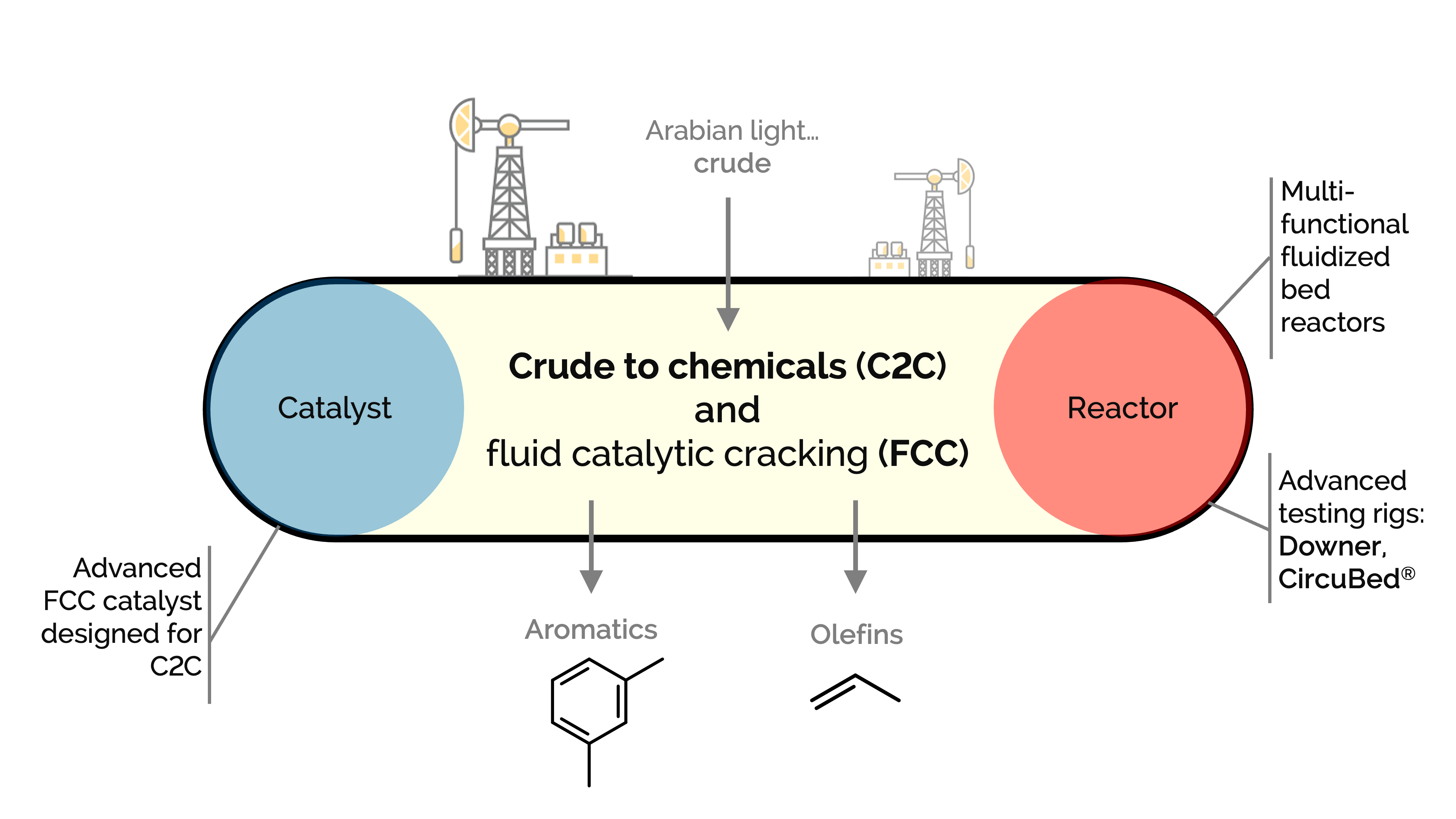
    Direct catalytic cracking of crude oil to chemicals could soon dominate the petrochemical industry, with lower fuel consumption and increased production of light olefins and aromatics. We aim to simplify the refinery into a single-step conversion scheme to produce the most demanded petrochemicals.

    Using a bottom-up holistic approach, we design a catalytic crude-to-chemicals process toward this goal. We investigate advanced reactors with intrinsic kinetic data and controlled hydrodynamics to improve the process. We study nonlinear multiscale phenomena by coupling hydrodynamics, heat transfer, and reaction kinetics.

    We use particle image velocimetry and optical probes, kinetic modeling, computational particle-fluid dynamics, and optimization approaches to improve operating scenarios and develop innovative reactor prototypes.

    We focus on the catalyst, reactor, and process levels to enhance and intensify the system. We are optimizing several state-of-the-art laboratory- and pilot-scale units, including a CircuBed®, a downer, and a multifunctional fluidized bed reactor.
    C2C-FCC

    Goals

    • Develop and scale up advanced reactors for converting crude oil to chemicals through fluid catalytic cracking, approaching intrinsic kinetics
    • Model process dynamics using reactive particle fluid dynamics coupled with experimental validations
    • Establish a design workflow for short-contact time reactors based on modeling, prototyping, and testing
    • Analyze the novel process developments in fluid catalytic cracking: novel feedstock, process modifications, etc.

    Related People

    Related Publications

    Polymeric Waste Valorization at a Crossroads: Ten Ways to Bridge Research on Model and Complex/Real Feedstock

    by Hita, Sarathy, Castaño
    Green Chem. Year: 2021

    Abstract

    The valorization of polymeric wastes, such as biomass, tires, and plastics, via thermal depolymerization (i.e., pyrolysis or liquefaction) and simultaneous or subsequent catalytic treatment has gained enormous momentum. The inherent hurdles when using complex polymeric wastes or their products as feedstock have led researchers to conclude that obtaining a fundamental kinetic understanding of the catalytic stage is unfeasible. To overcome the issues related to feedstock complexity, the majority of researchers have decided to use representative model compounds or probe molecules (i.e., surrogates). Two separate mainstreams have emerged in this field: one focusing on the fundamental kinetic understanding of model molecules and the other focused on studying real feedstock. We aimed to merge these approaches to utilize and acknowledge their potential and drawbacks. Therefore, herein, we provide ten recommendations for exploiting the existing synergies between the two approaches. This manuscript first contextualizes our proposed recommendations with a short overview on the thermocatalytic valorization field for polymeric waste, the complex compositions of reactants and products, the progress made in the individual fields of model and real feedstock, comparisons of both feedstock types, and some previous history on hydrocarbon conversion. Subsequently, we present guidelines for a truly cooperative and synergetic research effort.

    Keywords

    FCC REF HPC W2C ANW