​​

Reactor design and optimization for converting crude (and refinery wastes) to chemicals in one step through revamped fluidized catalytic cracking

    Problem Statement

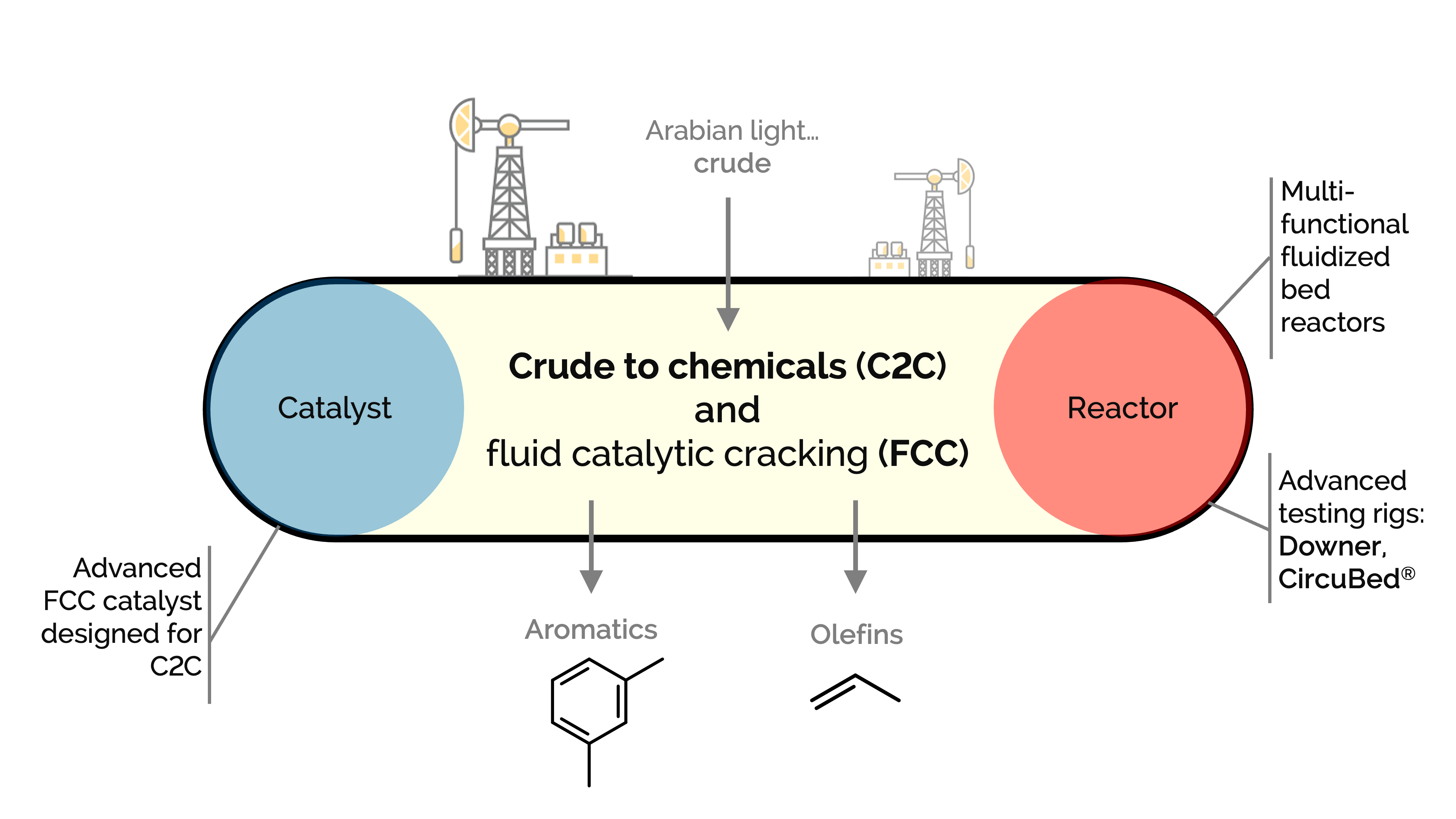
    Direct catalytic cracking of crude oil to chemicals could soon dominate the petrochemical industry, with lower fuel consumption and increased production of light olefins and aromatics. We aim to simplify the refinery into a single-step conversion scheme to produce the most demanded petrochemicals.

    Using a bottom-up holistic approach, we design a catalytic crude-to-chemicals process toward this goal. We investigate advanced reactors with intrinsic kinetic data and controlled hydrodynamics to improve the process. We study nonlinear multiscale phenomena by coupling hydrodynamics, heat transfer, and reaction kinetics.

    We use particle image velocimetry and optical probes, kinetic modeling, computational particle-fluid dynamics, and optimization approaches to improve operating scenarios and develop innovative reactor prototypes.

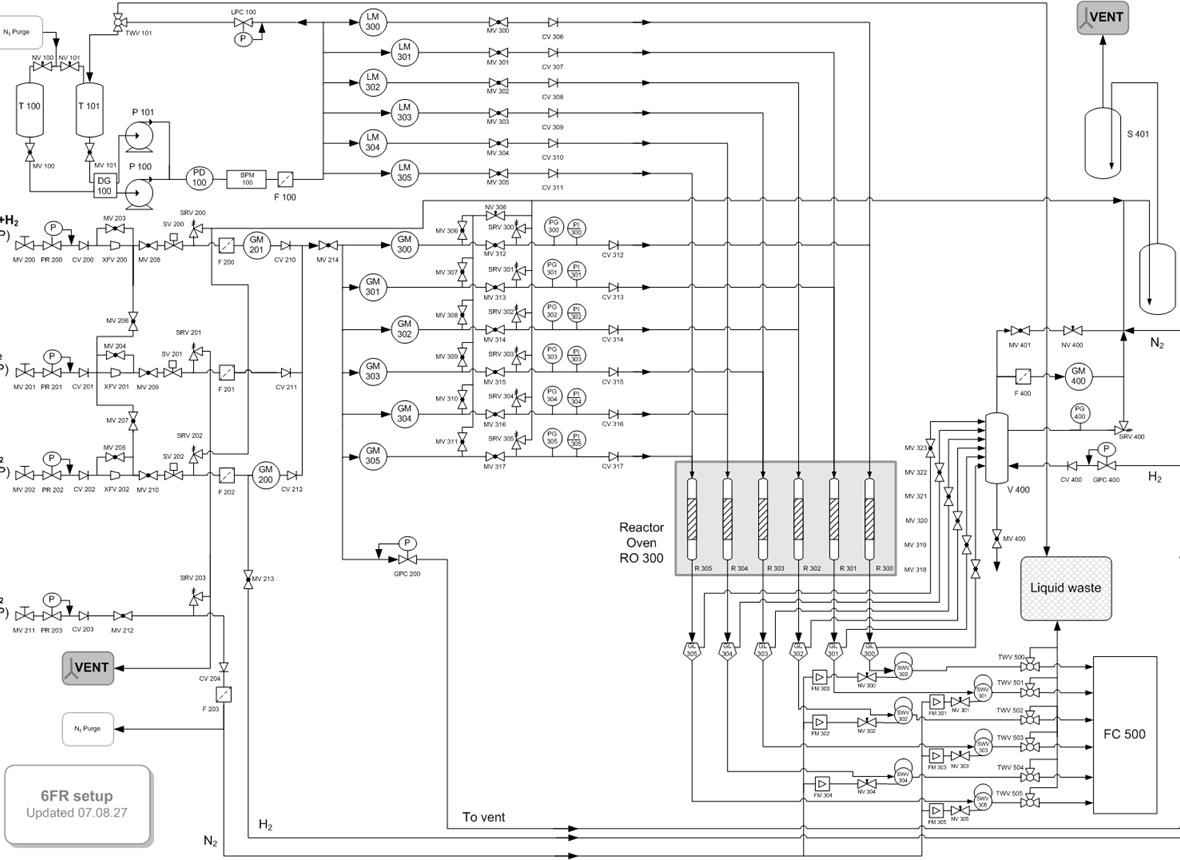
    We focus on the catalyst, reactor, and process levels to enhance and intensify the system. We are optimizing several state-of-the-art laboratory- and pilot-scale units, including a CircuBed®, a downer, and a multifunctional fluidized bed reactor.
    C2C-FCC

    Goals

    • Develop and scale up advanced reactors for converting crude oil to chemicals through fluid catalytic cracking, approaching intrinsic kinetics
    • Model process dynamics using reactive particle fluid dynamics coupled with experimental validations
    • Establish a design workflow for short-contact time reactors based on modeling, prototyping, and testing
    • Analyze the novel process developments in fluid catalytic cracking: novel feedstock, process modifications, etc.

    Related People

    Related Publications

    Pathways of Coke Formation on an MFI Catalyst during the Cracking of Waste Polyolefins

    by Castaño, Elordi, Ibanez, Olazar, Bilbao
    Catal. Sci. Technol. Year: 2012

    Abstract

    A study has been carried out on the deposition kinetics of carbonaceous-species on an acid  (containing an MFI ) in the cracking of high-density polyethylene and polypropylene. The initiation of coke deposition occurs on the acid sites, followed by aromatic and aliphatic growth in the micro- and mesopores, respectively.

    Keywords

    FCC W2C ANW MKM