​​

Reactor design and optimization for converting crude (and refinery wastes) to chemicals in one step through revamped fluidized catalytic cracking

    Problem Statement

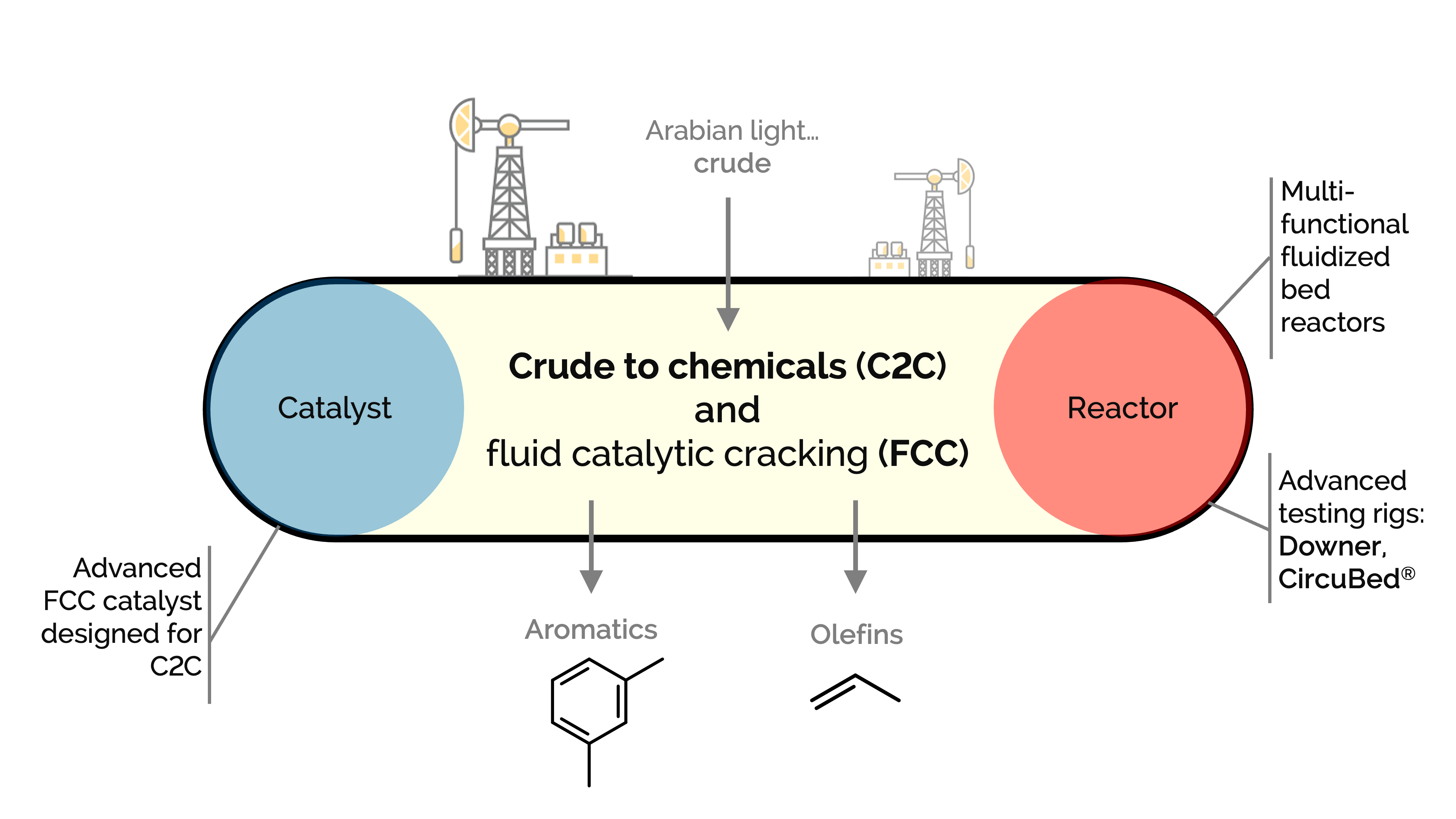
    Direct catalytic cracking of crude oil to chemicals could soon dominate the petrochemical industry, with lower fuel consumption and increased production of light olefins and aromatics. We aim to simplify the refinery into a single-step conversion scheme to produce the most demanded petrochemicals.

    Using a bottom-up holistic approach, we design a catalytic crude-to-chemicals process toward this goal. We investigate advanced reactors with intrinsic kinetic data and controlled hydrodynamics to improve the process. We study nonlinear multiscale phenomena by coupling hydrodynamics, heat transfer, and reaction kinetics.

    We use particle image velocimetry and optical probes, kinetic modeling, computational particle-fluid dynamics, and optimization approaches to improve operating scenarios and develop innovative reactor prototypes.

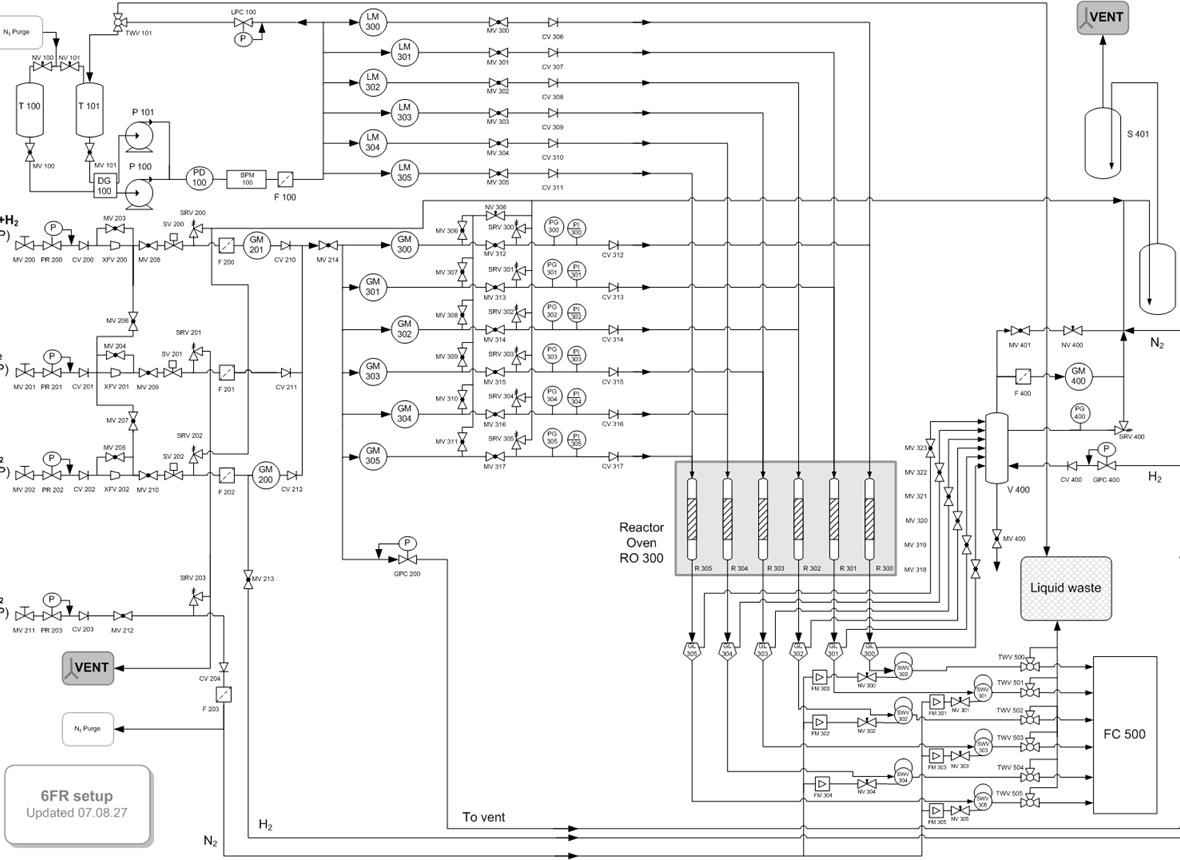
    We focus on the catalyst, reactor, and process levels to enhance and intensify the system. We are optimizing several state-of-the-art laboratory- and pilot-scale units, including a CircuBed®, a downer, and a multifunctional fluidized bed reactor.
    C2C-FCC

    Goals

    • Develop and scale up advanced reactors for converting crude oil to chemicals through fluid catalytic cracking, approaching intrinsic kinetics
    • Model process dynamics using reactive particle fluid dynamics coupled with experimental validations
    • Establish a design workflow for short-contact time reactors based on modeling, prototyping, and testing
    • Analyze the novel process developments in fluid catalytic cracking: novel feedstock, process modifications, etc.

    Related People

    Related Publications

    Dual Coke Deactivation Pathways during the Catalytic Cracking of Raw Bio-Oil and Vacuum Gasoil in FCC Conditions

    by Ibarra, Veloso, Bilbao, Arandes, Castaño
    Appl. Catal. B: Environ. Year: 2016

    Extra Information

    Open Access.

    Abstract

    Coke deposition pathways have been studied during the fluid catalytic cracking of bio-oil, vacuum gasoil (VGO) and a blend of the previous two (80 wt% VGO and 20 wt% bio-oil), under realistic riser conditions of the fluid catalytic cracking (FCC) unit, using a commercial catalyst at 500 °C and contact times of 1.5–10 s. Amount and composition of soluble and insoluble coke in dichloromethane have been analyzed using a set of techniques (TPO, FTIR, 13C NMR, XPS, Raman, GC–MS and MALDI-TOF MS, among others). The relationship of coke deposition with its composition and the reaction medium has allowed us to set two pathways of coke formation: (i) heavy hydrocarbon pathway tend to form ordered polycondensed aromatic nanostructures; whereas (ii) oxygenate pathway tend to form a lighter fraction of coke containing oxygen, less ordered and more aliphatic coke. A synergy between the two pathways have been verified due to the lower coke deposition of the blend compared to the individual components, and this has been explained in terms of (i) attenuation of the heavy hydrocarbon pathway caused by the steam contained or originated from the bio-oil, and (ii) the hydride transfer from hydrocarbons to the precursors of the oxygenate pathway.

    Keywords

    O2H FCC W2C MKM