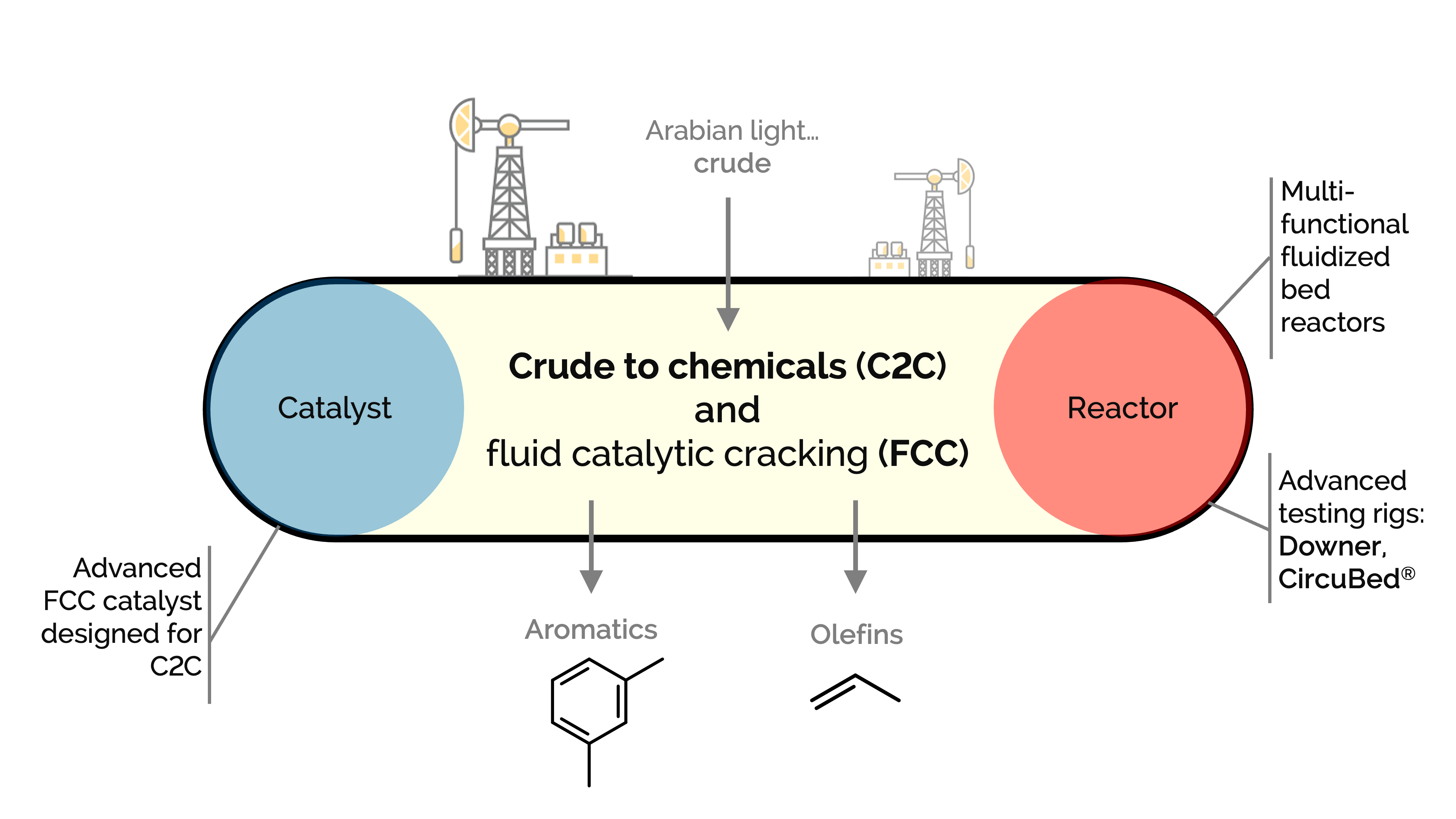
Direct catalytic cracking of crude oil to chemicals could soon dominate the petrochemical industry, with lower fuel consumption and increased production of light olefins and aromatics. We aim to simplify the refinery into a single-step conversion scheme to produce the most demanded petrochemicals.
Using a bottom-up holistic approach, we design a catalytic crude-to-chemicals process toward this goal. We investigate advanced reactors with intrinsic kinetic data and controlled hydrodynamics to improve the process. We study nonlinear multiscale phenomena by coupling hydrodynamics, heat transfer, and reaction kinetics.
We use particle image velocimetry and optical probes, kinetic modeling, computational particle-fluid dynamics, and optimization approaches to improve operating scenarios and develop innovative reactor prototypes.
We focus on the catalyst, reactor, and process levels to enhance and intensify the system. We are optimizing several state-of-the-art laboratory- and pilot-scale units, including a CircuBed®, a downer, and a multifunctional fluidized bed reactor.
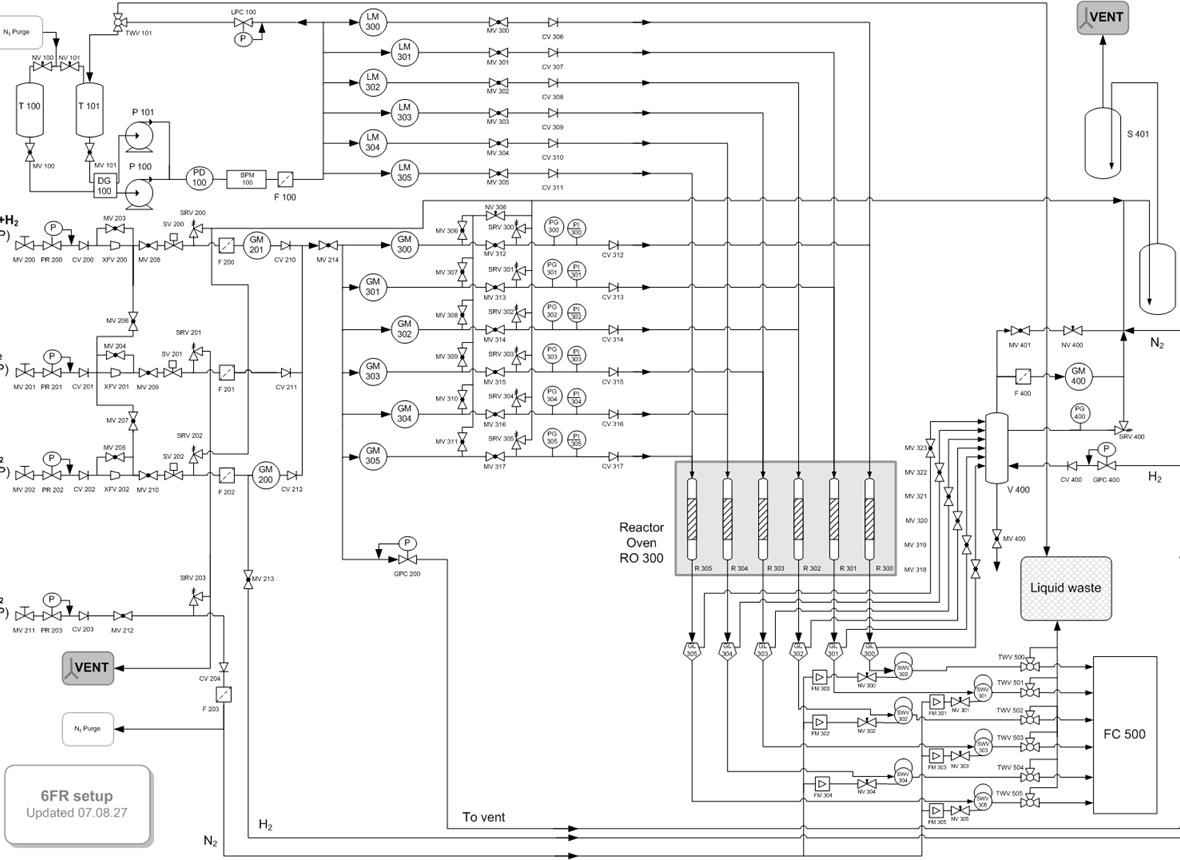
The effect of co-cracking of high-density polyethylene (HDPE) or its pyrolysis wax together with vacuum gasoil (VGO) has been studied. The aim is to determine the content, nature, and location of coke while analyzing the impact on product distribution in the process. Four different feeds were used (VGO, VGO + 5 wt% HDPE, VGO + 20 wt% of wax, and 100 wt% wax) in experiments performed in a laboratory-scaled riser simulator, with similar conditions to those of the fluid catalytic cracking(FCC) unit: equilibrium catalyst; 530 °C; catalyst/feed mass ratio, 5; contact time, 6 s. The results of the different characterization techniques of the deactivated catalyst and the coke indicate that the catalyst foulingdecreases notably by incorporating these waste streams, changing its nature to a more aliphatic (olefinic) one and its location towards the zeolite micropores. On the contrary, the coke formed from the VGO is more evolved and mainly constituted by polyaromatic components deposited on the mesopores of the catalyst matrix. Product distribution is also affected, increasing the yield of light cycle oil and keeping a relatively similar gasoline yield, with greater olefinity and lower aromaticity. Thus, the FCC shows great perspectives to valorize polyolefins, present in waste plastics, at great scale.