​​

Towards a feasible and stable thermocatalytic conversion of CO₂ to methanol and E-fuels


    Problem Statement

    Unarguably, CO₂ is a crucial concern affecting climate change. To address the issue, viable valorization strategies are required to efficiently use CO₂ and enable a circular economy. We aim to convert CO₂ into CO, methane, methanol, dimethyl ether, or E-fuels.

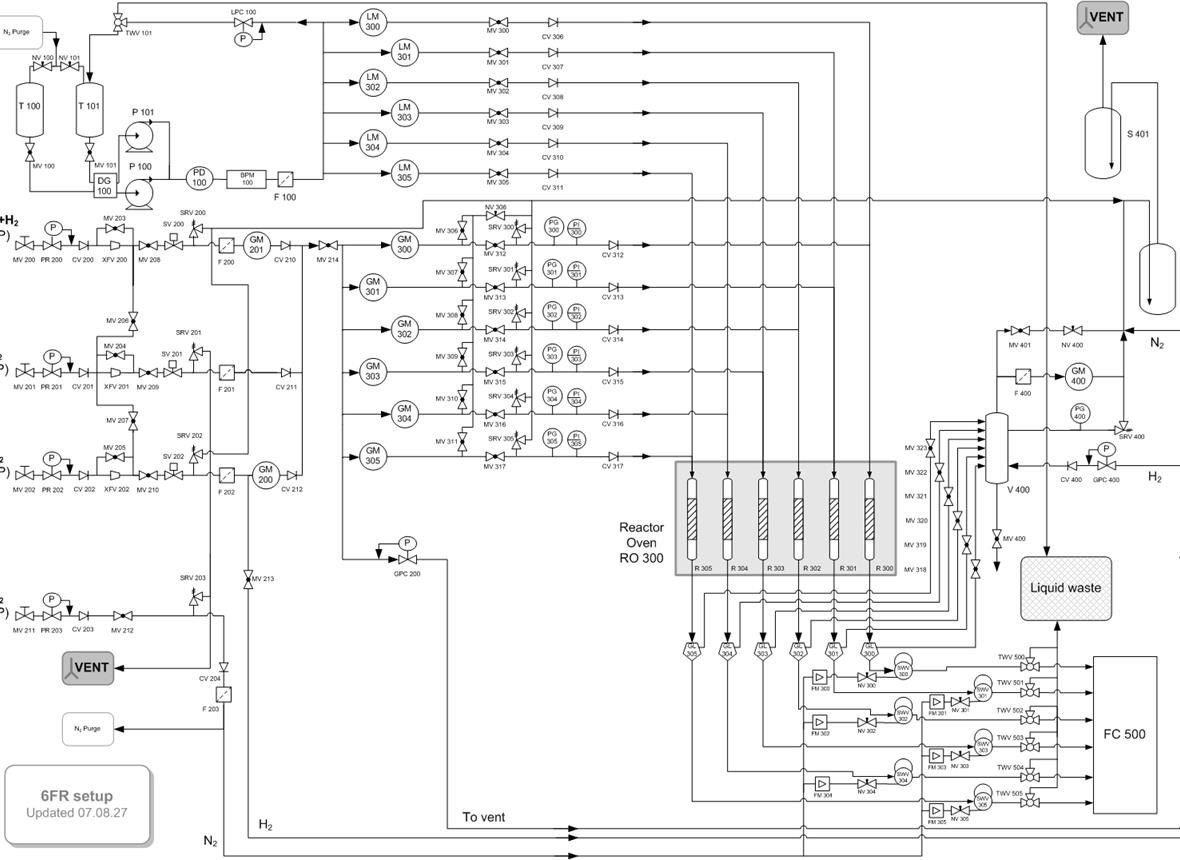
    Our activities in CO₂ utilization are related to (i) analyzing the stability of industrially relevant catalysts under realistic conditions and (ii) developing new catalytic materials based on Cu. In (i), we are developing reactors that augment the kinetic information: (a) in situ and operando spectroscopic reactors that work under (close to) working conditions to study structure-performance relationships, (b) periodic reactors with transient or variable conditions over time or space. In (ii), we work mainly with novel materials such as metal-organic frameworks (MOFs).

    We guide the design of these catalysts based on stability and using density functional theory (DFT) and microkinetic modeling.

    Another research line associated with CO₂ utilization is the electroreduction or CO2RR, explained on the EPB site.

      CO2

      Goals

      • Develop advanced structure-function-deactivation relationships of industrially relevant catalysts
      • Analyze the effect of “activity modifiers,” such as sulfur species, aromatics, chlorine, etc., on the catalyst structure and performance
      • Improve the catalyst structure-function correlations using in-situ, operando, and dynamic techniques and reactors
      • Synthesize new catalytic materials with enhanced stability and selectivity
      • Develop a microkinetic-based modeling framework to analyze the catalyst performance

      Related People

      Related Publications

      Induced Restructuring of a Supramolecular Metal–Organic Framework into a Cu–Zn Alloy Catalyst for Reverse Water–Gas Shift

      by Velisoju, Pascual-Colino, Dally, AlAreeqi, Virpurwala, Nassereddine, Mohamed, Trueba, Bai, Mena-Gutiérrez, Davaasuren, Hassine, Morlanes, Ramos-Fernandez, Aguilar, Castillo, Castaño
      Angewandte Chemie Year: 2026 DOI: https://doi.org/10.1002/anie.4933664

      Abstract

      In Cu–Zn catalysts used for the reverse water–gas shift (RWGS) reaction, Cu and Zn phases remain dispersed, while the Cu–Zn interphase is widely regarded as the catalytically active site. Herein, we engineered a ZnO-decorated Cu-rich Cu–Zn alloy using a mixed Cu/Zn oxalate-based supramolecular metal–organic framework precursor with compositionally homogeneous Cu/Zn mixing. The resulting Cu–Zn catalyst (Cu–Zn|C-oxo|R) maintained >99% CO selectivity and, at 550 °C, delivered a Cu-normalized CO space–time yield (STY) of 1580 mmol(CO) g(Cu)−1 h−1, higher than those of the Cu-only and commercial Cu–Zn–Al benchmarks. Under a high space velocity test, the Cu–Zn|C-oxo|R catalyst remained stable for >50 h at 550 °C. Operando Cu K-edge x-ray absorption spectroscopy shows that Cu is reduced to a predominantly metallic local environment that persists under RWGS conditions. Complementary in situ x-ray diffraction and electron microscopy identify Cu-rich Cu–Zn alloy domains in contact with ZnO, while in situ diffuse reflectance infrared Fourier transform spectroscopy is consistent with an associative formate-mediated RWGS pathway at these interfaces. Density functional theory calculations further revealed that these interfacial sites favor the formate reaction pathway, providing a molecular-level rationale for the enhanced catalytic activity.

      Keywords

      CO2 HCE