Our research is at the interface between chemical engineering, catalysis, surface kinetics, analytical, and physical chemistry. We aim to bridge the fundamental aspects of chemical reactions and catalysis with reactor design and process development. Our core competencies are:
MuRE develops reaction engineering technologies spanning catalysts, reactors, and multiscale models. Our projects integrate synthesis, shaping, testing, modeling, and scale-up to deliver deployable solutions for energy, chemical production, waste valorization, circular carbon, hydrogen production, sulfur removal, and hydrocarbon intensification, bridging fundamental chemistry with industrial reactor concepts and pilot-ready systems.
The catalytic processes we investigate fall into (1) hydrocarbon sustainability, (2) alternative feedstock and (3) circular carbon economy and waste-valorization, such as the transformations of small molecules (carbon dioxide, methane, ammonia, alkanes, methanol) or bulkier ones in complex mixtures (refinery residues, crude, biomass, lignin, plastic wastes, used tires) into hydrogen, light olefins/alkenes, platform chemicals or high-quality fuels.
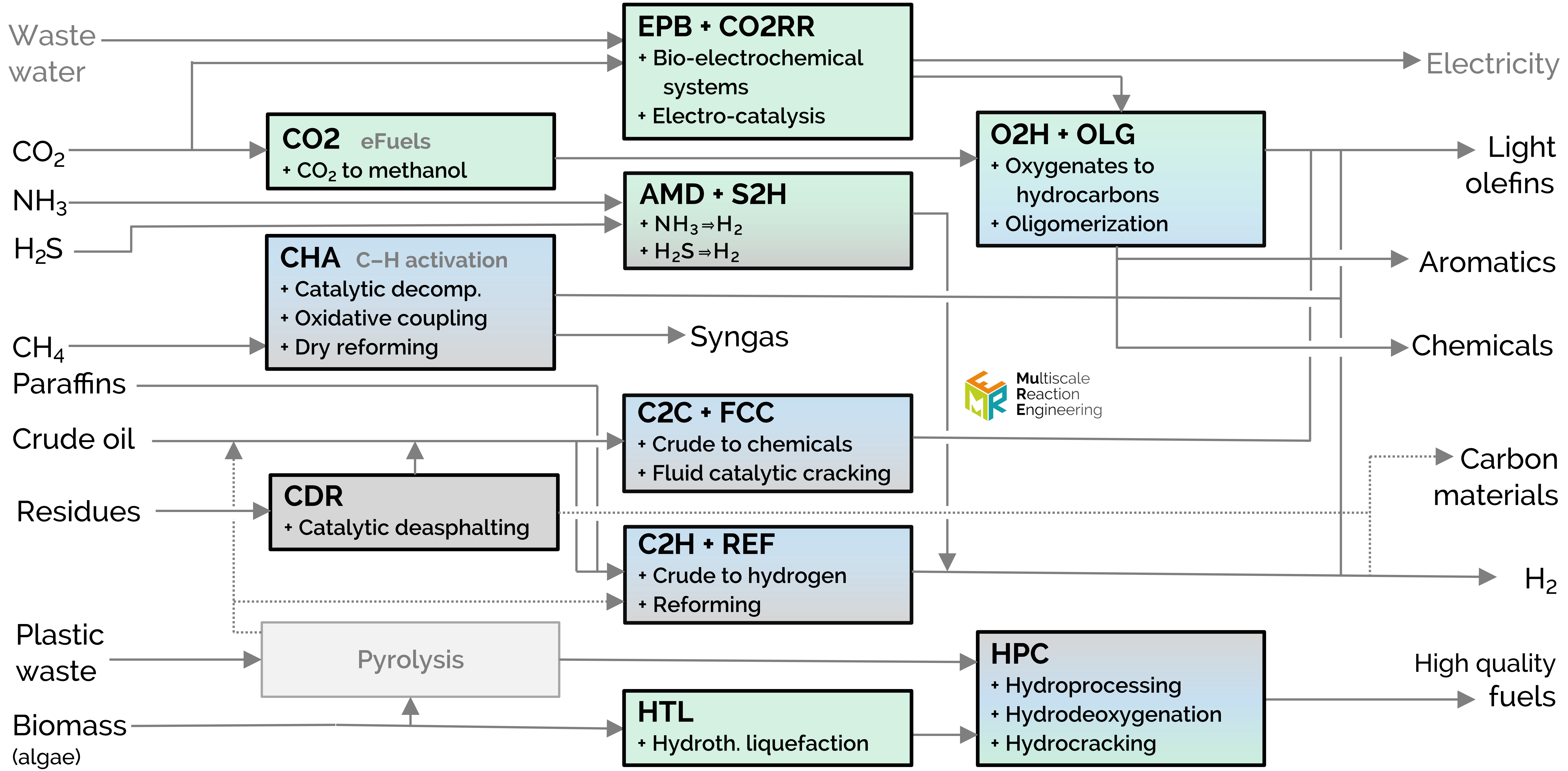
Below is an overall scheme of processes we investigate and more details about them, who works here, and our publications.
Process development for the deasphalting of crude and residues using heterogeneous catalysts
Reactor design and optimization for converting crude (and refinery wastes) to chemicals in one step through steam-fluidized catalytic cracking
Design and development of unconventional catalytic conversion processes using electrons, photons, and microorganisms
Designing sustainable routes to produce fuels and chemicals from algae trough catalytic liquefaction